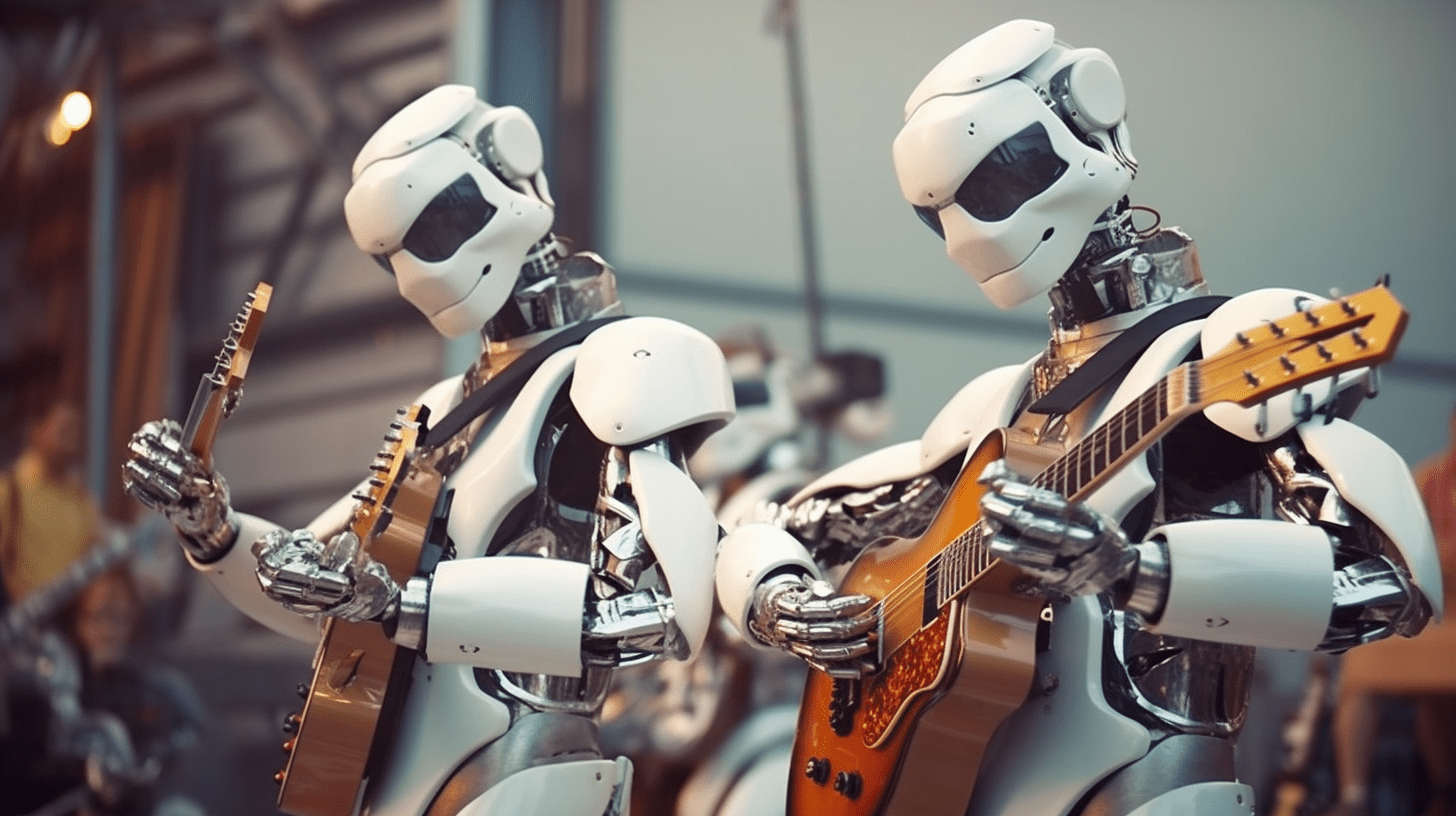
Recent advancements in artificial intelligence (AI) technology have led to great strides in generating music using machine learning algorithms. Tech giants such as Meta, the parent company of Facebook, and Google have developed their own music generators, but which is more efficient? Can AI-generated music be held up to professional standards? These are just a few of the questions we seek to answer as we examine the capabilities of these AI music generators.
Meta’s Music Gen
Meta, the company behind Facebook, recently published a paper titled “Simple and Controllable Music Generation,” which presents their AI-generated music called Music Gen. Music Gen uses efficient token interleaving patterns to produce high-quality audio and can also be conditioned on a given melody to influence its sound. The AI model was trained on over 20,000 hours of music, including 10,000 high-quality tracks as well as music data from Shutterstock and 0.5. One of the key advantages of Music Gen is its “controllability”, which allows composers to guide the machine-generated melodies toward their original idea.
Note, however, that even though Music Gen outperformed Google’s Music LM on a standard text-to-music benchmark, both generators produced some inconsistencies in their music generation. Another limitation is that the current sample set used for training on Music Gen may not be comprehensive enough to produce accurate results for all genres of music.
Google’s Music LM
On the other hand, Google’s Music LM model is also valuable within the scope of machine-generated music and was trained on over 68,000 MIDI files including Mozart, Bach, Beethoven, and other classical composers’ works. Although Google’s music model works well enough for generating classical music, it may not have met the required conditions to perform well in the direct comparison with Music Gen. It’s also important to note that the musical output from Google’s Music LM sometimes falls short of sounding professional, which is something to be aware of if seeking to use machine-generated music in your professional work.
The Future of AI-Generated Music
AI-generated music has the potential to transform the music industry and deliver quick background music options for various commercial industries such as film, video, and gaming. Open-source projects like Music Gen and Music LM have perks where talented individuals and small teams can work to make the models more consistent with the aim of creating fully functional models soon.
One drawback of AI-generated music is that the sample sets used to train the AI models may not be extensive enough for all music genres. Recent developments have shown that AI-generated relaxing jazz music is of very good quality, whereas upbeat arcade music does not fare well and produces inconsistency or poor musical output. Therefore, it is essential that more comprehensive sample sets be used to train AI music models that can deliver accurate and consistent results across all music genres. By modifying the algorithm and the training data to reflect the specificity of a certain genre, the music generator can be optimized to produce artificial music in a given style.
In conclusion, AI-generated music has the potential to expand the music industry by delivering quick background music options for commercial industries and for amateur musicians. While both Music Gen and Music LM deliver some inconsistencies in the generated music, with further development and larger sample sets to train on, the music will likely become more accurate. The machine-generated music output is now at par with amateur human composers, and soon the AI machine could create music that is difficult to differentiate from professional composers. Only time will tell!