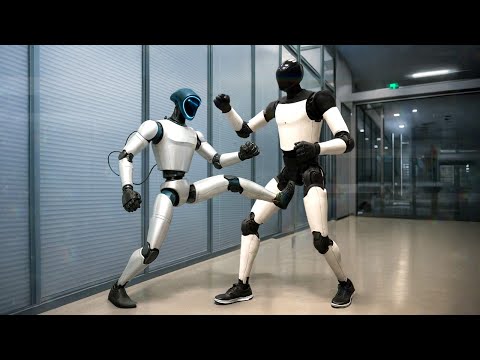
In the ever-evolving world of robotics, two humanoid robots have recently captured the public’s imagination: Tesla’s Optimus and Unitry’s G1. These robots represent the pinnacle of current robotic technology, each bringing unique capabilities and philosophies to the table. As these two giants compete, they push the boundaries of what’s possible, offering a glimpse into the future of autonomous systems. In this article, we will delve into the technological advancements, real-world applications, and the industrial rivalry driving their development, providing insights into the future trajectories of these groundbreaking machines.
Introduction to Tesla’s Optimus and Unitry’s G1 Humanoid Robots
Tesla’s Optimus and Unitry’s G1 have recently made headlines due to their impressive capabilities showcased in recent demonstrations. Optimus has shown improved real-time movement and learning abilities powered by advanced AI, whereas Unitry’s G1 has made strides in resilience and recovery from impacts. These humanoid robots are designed not only to perform complex tasks but also to adapt and learn from their environments, positioning them as potential game-changers in various industries.
Technological Advancements and Capabilities
Optimus, developed by Tesla, utilizes sophisticated AI to learn coordination and timing for complex maneuvers. However, it still faces challenges with hand dexterity, indicating ongoing development. On the other hand, Unitry’s G1 emphasizes resilience, demonstrating the ability to absorb impacts and autonomously recover from falls. This resilience is critical for real-world applications where robots need to maintain functionality under adverse conditions. Advanced sensor technology enables G1’s impressive weight-shifting mechanics, making it a sturdy and reliable option for practical applications.
Real-World Applications and Challenges
Both Optimus and G1 are designed with real-world applications in mind. Tesla plans to deploy thousands of Optimus robots in its factories by 2025, aiming to enhance production efficiency and reduce costs. Despite this ambitious goal, the complexity of ensuring reliability and safety in humanoid robots presents significant challenges. Unitry’s G1, priced at around $16,000, offers a more accessible option for research labs and startups. Its ability to recover from falls autonomously makes it suitable for environments where external assistance may not be available.
The Philosophical and Strategic Divide
The development of Optimus and G1 reflects a broader philosophical and strategic divide between Tesla and Unitry. Tesla represents a refined, closed ecosystem focused on integrating AI with robotics for seamless performance. In contrast, Unitry embraces an open, cost-effective model that allows for flexible deployment and broader experimentation. This approach not only fosters rapid iteration based on real-world feedback but also makes advanced robotic technology more accessible to a wider audience.
Security Concerns in Modern Robotics
The integration of advanced robotics into everyday applications raises important security concerns. Unitry’s G1, for instance, has vulnerabilities related to Bluetooth communications and data telemetry practices, which could potentially be exploited. Ensuring the security of autonomous systems is crucial, especially as they become more interconnected and integrated into sensitive environments. While these issues can be patched, they highlight the need for robust security measures in modern robotics.
Global Industrial Rivalry and Its Implications
The competition between Tesla and Unitry is a microcosm of the broader industrial rivalry between the US and China in the field of robotics. While the US focuses on optimized, high-tech solutions, China adopts a model of faster iteration and public deployment. This industrial competition is reflected in the advancements of both Optimus and G1, as well as contributions from other tech giants exploring humanoid robotics. The rivalry fuels innovation, pushing both nations to develop cutting-edge technologies that will shape the future of industry and beyond.
Conclusion: Future of Humanoid Robotics
As both Tesla’s Optimus and Unitry’s G1 continue to evolve, they offer distinct visions of the future of humanoid robotics. Optimus emphasizes intelligence and integration within a controlled ecosystem, while G1 focuses on resilience and real-world applicability. Although neither robot has fully mastered dexterous manipulation, their advancements in movement stability and impact recovery are significant. The ongoing competition between these two models reflects a larger trend in robotics, where innovation is driven by diverse approaches and industrial needs. The future of humanoid robotics holds immense potential, promising to revolutionize labor, autonomous systems, and beyond.