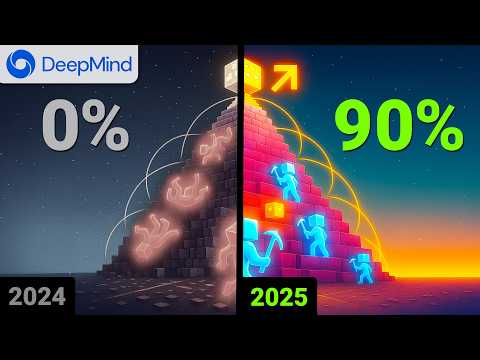
In the rapidly evolving field of artificial intelligence, breakthrough advancements are no longer a rarity. Yet, some innovations still manage to set new standards and ripple through the tech community with a forceful impact. One such groundbreaking development has come from Google DeepMind, whose new AI has mastered the complex environment of Minecraft with a minimal amount of training data. This leaps far ahead of its predecessors who relied extensively on millions of hours of human gameplay footage. How did Google DeepMind achieve this feat? Come, explore the intelligent intricacies behind this AI marvel.
Introduction to Google DeepMind’s AI Breakthrough in Minecraft
Google DeepMind’s latest AI has demonstrated a remarkable capability to excel at Minecraft without the intensive training data traditionally deemed necessary. Unlike earlier models, which relied on vast datasets and direct game interaction, this AI built its abilities through innovative, minimalistic approaches. By leveraging a small amount of gameplay footage, the AI constructed a ‘world model’—essentially a neural simulation of Minecraft. This allowed it to learn, practice, and master the game within its internally created environment, setting a newfound precedent in AI training techniques.
Phase 1: World Model Pretraining
The foundation of this AI’s success lies in the first phase known as ‘World Model Pretraining.’ Here, the AI initially observes a limited number of gameplay videos to develop a mental representation of the Minecraft world. Think of this as the AI creating an internal map and understanding the game’s dynamics and intricacies. This stage is crucial, forming the bedrock upon which further learning and practice are built.
Phase 2: Learn What Matters – Innovative Feedback System
Once the AI has a basic understanding of the game environment, it enters the second phase, termed ‘Learn What Matters.’ This phase incorporates an innovative feedback system where the AI is programmed to assign values to its actions through a point system. For example, performing successful mining actions earns the AI points, reinforcing its learning patterns. This feedback loop ensures that the AI focuses on mastering pivotal aspects of the game that lead to success and optimization.
Phase 3: Practicing in Dreams – Simulated Gameplay
The third phase takes the learning process to a more sophisticated level through ‘practicing in dreams.’ In this stage, the AI simulates countless gameplay scenarios within its internally constructed world model. It’s akin to performing rehearsals in a dreamlike state where the AI practices thousands or even millions of times, refining its strategies and actions to achieve objectives effectively, such as obtaining a diamond. This method allows for an extensive number of consecutive actions, sometimes up to 20,000, far exceeding human gameplay capabilities.
Comparison with OpenAI’s Video Pre-Training (VPT)
A critical comparison is often drawn between this new AI and OpenAI’s earlier Video Pre-Training (VPT) models. The VPT models utilized a staggering 250,000 hours of annotated footage, a stark contrast to the minimal data used by Google DeepMind’s AI. Despite this discrepancy, the new AI has showcased unparalleled performance, especially in mining resources, by efficiently learning intrinsic game mechanics with just 1/100th of the data required by VPT models. This efficiency underscores how far AI training methodologies have advanced.
Broader Applications of Imagination Training
The success of this AI in Minecraft isn’t limited to gaming alone. The imagination training technique employed here has vast potential applications in numerous fields. For instance, the AI’s ability to simulate real-world scenarios can be ported to robotics, where it can imitate various real-world phenomena like object behavior and environmental interactions. This paves the way for advanced automated systems and refined human-robot interactions.
Limitations and Future of AI in Gaming and Beyond
Despite its groundbreaking achievements, the AI is not without limitations. Currently, it struggles with long-term predictions and maintaining consistency over extended sequences of actions. Its reliance on quick, discrete feedback can lead to significant misjudgments over time, limiting its effectiveness in ongoing, dynamic scenarios. Nevertheless, these shortcomings provide valuable insights for future research, driving the continual evolution of AI capabilities not just in gaming but across various practical applications.
In conclusion, Google DeepMind’s groundbreaking AI has not only revolutionized the approach to gaming but also offers intriguing possibilities for broader real-world applications. With minimal training data and innovative simulation techniques, this AI has indeed set a new benchmark in the realm of artificial intelligence.