Introduction to AI Agents and Robots in Soccer
Soccer is a sport that has been enjoyed by people of all ages around the world for centuries. It is a game that requires intense physical and mental preparation, as well as a high level of skill and coordination. In recent years, the integration of artificial intelligence (AI) in soccer has revolutionized the way the game is played.
Scientists at DeepMind have been at the forefront of this revolution, successfully training AI soccer agents to play with expert-level proficiency. Although it took five years of simulated training for the AI, the agents were still able to master the game in just three simulation days. This incredible feat was made possible by teaching the agents to think ahead, position themselves correctly, and anticipate their teammates’ behavior.
The agents are also exceptional at making saves, which shows how advanced AI technology has become. This breakthrough is a significant step towards a future where robots can play soccer at a professional level.
Another notable paper by scientists at OpenAI explored the use of simulation-to-reality applications in robot soccer. The team used a video game environment to simulate robot hands and then deployed the robots in the real world based on what they had learned in the simulation. From this, they were able to teach the robots how to score goals and get up quickly after falling.
Unfortunately, the robots suffered from knee injuries due to the intense physical activity. Nevertheless, the scientists were quick to make adjustments to reduce the risk of knee injuries. As a result, the robots can now run, score goals, and control the ball with ease.
The robots’ success on the soccer field, however, depended on their ability to move in a way that was not too hard on their knees. This factor has encouraged researchers to explore how robots can move more efficiently while playing soccer.
The progress made in robot soccer, thanks to AI, is a significant milestone in the development of autonomous systems for sports. The advances made in AI will undoubtedly continue to propel the field of robotic soccer forward in the years to come. This incredible technology will allow us to witness robotics and AI in action as never before, revolutionizing the game of soccer as we know it.
DeepMind’s Successful Training of AI Agents in Soccer
Soccer is a complex sport that requires players to strategize, anticipate, and coordinate movements with their teammates. Not surprisingly, teaching artificial intelligence (AI) agents to play soccer has proven to be a challenging task. However, scientists at DeepMind – the AI research lab owned by Google – have made significant strides in this area, demonstrating the power of simulation-based training.
DeepMind’s training approach employs a reinforcement learning algorithm that enables the AI agents to learn from their mistakes, improving their performance over time. To train the AI agents, the researchers developed a simulation environment that accurately emulates the game of soccer. The agents were given a set of possible actions, such as passing the ball, shooting, or moving to a specific location on the field, and were tasked with controlling their players to achieve a specific goal, such as scoring a goal or defending their own goal.
What sets DeepMind’s approach apart is its use of simulated game scenarios to train the AI agents. By simulating thousands of games, the agents are exposed to a wide range of situations, allowing them to learn and adapt their strategies. What’s more, the simulation environment enables the researchers to quickly iterate on the training process, adjusting the parameters and rules to optimize the agents’ performance.
The results of DeepMind’s training are impressive. The AI agents are able to maneuver around the field, passing the ball to their teammates, and taking shots on goal. They can even predict the actions of their opponents and use this information to adjust their own strategies. The agents have learned to work together as a team, coordinating their movements in a way that maximizes their chances of winning.
Perhaps most remarkable of all is the speed at which the AI agents were able to learn. While it may have taken five years for an actual person to master the game of soccer, it only took three days of simulation time for the AI agents to achieve a similar level of expertise.
There are still challenges to overcome, of course. One major issue is the “sim-to-real gap,” where an AI agent’s performance in the simulation environment does not necessarily translate to the real world. However, there are already promising efforts underway to address this issue. For example, OpenAI (a research lab co-founded by Elon Musk) has successfully demonstrated how an AI agent’s skills in a simulated environment can be transferred to the physical world. By first training the agent in a simulated environment and then allowing it to refine its skills in a real-world setting, the researchers were able to teach a robot hand to manipulate objects, a feat that was once thought impossible.
Overall, the success of DeepMind’s AI agents in soccer is a clear indication of the power of simulation-based training. With continued research and innovation, we may soon see AI agents and robots capable of mastering even more complex tasks – with applications that reach far beyond the world of sports.
OpenAI’s Simulation-to-Reality Application in Robot Soccer
As we have previously discussed, AI agents have made significant progress in mastering the game of soccer through computer simulations. These simulations allow AI agents to train and improve their skills, positioning, strategy, and teamwork in a controlled environment with minimal risk of injuries. However, transferring these skills learned in a simulated environment to the real world has posed a significant challenge for researchers.
Researchers at OpenAI have come up with a novel way of overcoming this challenge through a simulation-to-reality application that uses advanced robotics. In a research paper published in 2018, they demonstrated how they successfully trained a pair of robotic arms to solve Rubik’s Cube using a combination of simulation and real-world training. Building on this accomplishment, they extended this approach to the game of soccer.
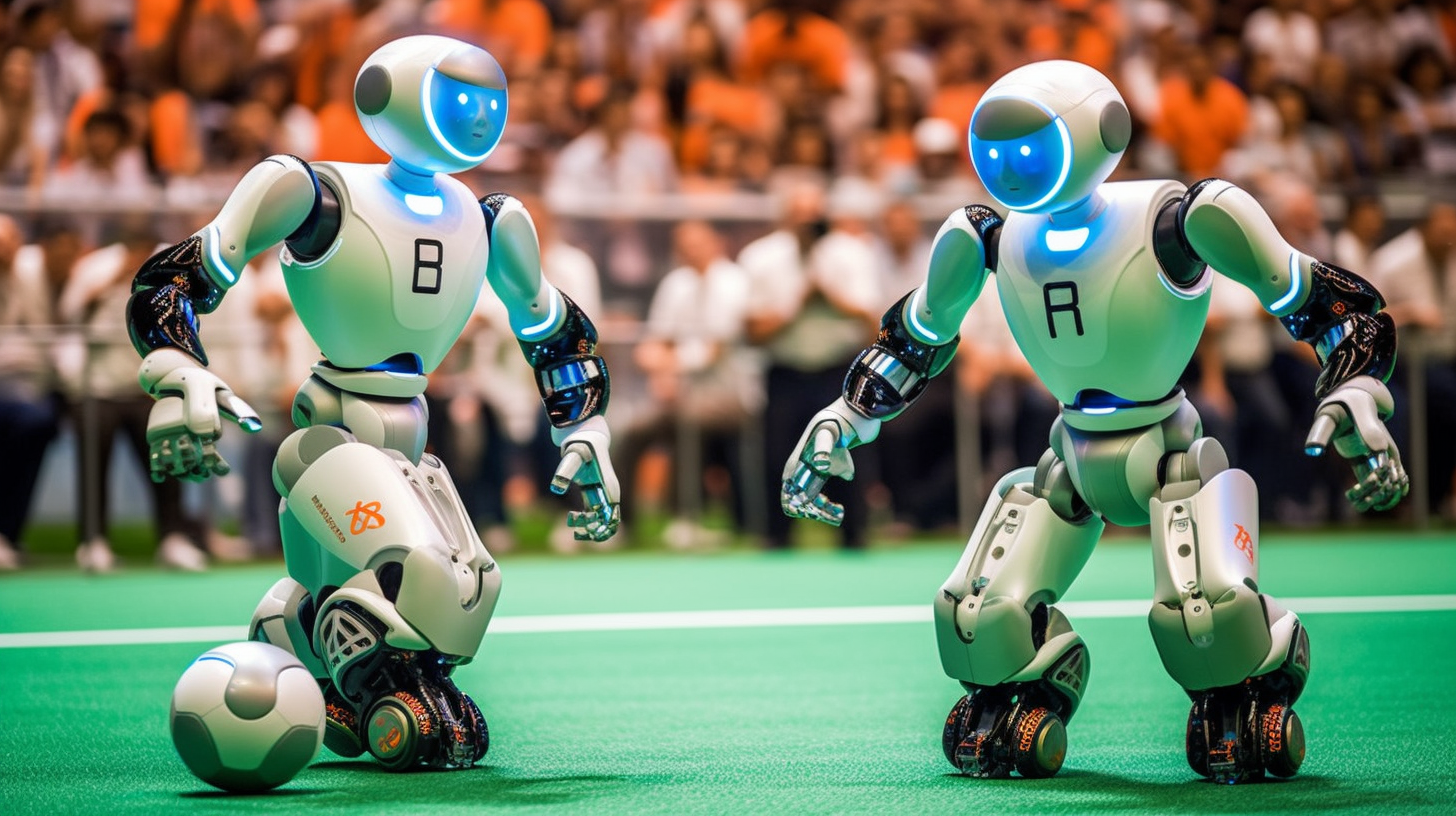
In the experiment, two real robots with 20 motion joints were trained to play soccer using a simulation-to-reality approach. The robots were first trained in a virtual environment to learn the game’s fundamentals, such as shooting, passing, dribbling, and defending, without the fear of injury. The simulation allowed them to experiment with different approaches and strategies to improve their gameplay.
Once they showed significant progress, the robots were deployed into the real-world environment, where they faced challenges such as the effects of gravity, friction, and physical impacts with other players. They were also taught to recover from random perturbations, which would destabilize them. The robots quickly adapted to this new environment and demonstrated remarkable proficiency in executing the skills they learned in the simulation.
However, one significant challenge the researchers faced was knee injuries in the robots. Like human soccer players, the robots faced the risk of joint injuries due to the sudden changes in movements and impacts with other players. The researchers found a novel way to teach the robots to reduce stress on their knees by changing how they moved. The robots were taught to move in a way that emphasized balance, stability, and efficient use of their joints, which significantly reduced their risk of injury.
Through this simulation-to-reality application in robot soccer, OpenAI researchers demonstrated the potential of AI agents to master complex tasks that involve real-world challenges. The experiments showed how AI agents can learn fundamental skills in simulation and transfer them to the real world to improve performance and overcome barriers.
However, this achievement also highlights the need for researchers to consider the physical limitations and safety of AI agents, particularly in challenging and potentially dangerous environments. It is essential to strike a balance between pushing the limits of AI development and ensuring AI agents’ safety and ethical considerations.
In conclusion, OpenAI’s simulation-to-reality application in robot soccer is a significant milestone in AI development and robotics. Through innovative approaches to learning and training, AI agents and robots can overcome significant challenges and improve their performance in complex tasks. The future looks bright for AI development in sports, and we can only imagine what other remarkable achievements are yet to come.
Overcoming Challenges: AI Robots Moving Beyond Joint Injury
As AI agents and robots continue to master soccer, it is inevitable that they will face challenges and obstacles along the way. One such challenge that has been encountered by the developers of AI soccer robots is joint injury. When these robots were first introduced, their knees were taking a beating due to the intense movements required of them on the field. This led to a lot of downtime and maintenance, which decreased their efficiency and effectiveness on the field, hindering the progress of AI in the sport.
However, this problem has now been addressed and overcome through the dedication and ingenuity of scientists and developers. They have found innovative ways to allow AI soccer robots to move with ease and grace while minimizing the stress on their joints. This has led to remarkable progress in the development and deployment of AI soccer robots in the real world, and the results are nothing short of impressive.
One such example is the work of scientists at OpenAI, who trained robots with 20 motion joints to play soccer and score goals. However, the initial simulation led to the development of muscular imbalances, which led to joint stress and injury. The solution involved optimizing the gait of the robots, allowing them to move more easily, and reducing the overall stress on their joints. This approach allowed the robots to move faster, shoot more accurately, and score more goals.
The solution was not just beneficial for AI soccer robots but for all types of robots with motion joints. It helped eliminate many of the issues and bottlenecks experienced by robots with complex movements, reducing maintenance times and increasing overall efficiency.
Another example of overcoming this challenge is the work of scientists at DeepMind. They developed AI agents that could anticipate the behavior of their teammates, and this allowed them to move more easily and with greater flexibility and effectiveness. They were able to position themselves better and anticipate the actions of their opponents, leading to better overall performance on the field.
In summary, the development of AI soccer robots has faced many challenges, and joint injury is one of them. However, through ingenuity and dedication, scientists and developers have found ways to overcome this obstacle, allowing AI soccer robots to move with greater ease, grace, and effectiveness. As more research is conducted in this field, it is expected that AI soccer robots will continue to evolve and improve over time, leading to even more remarkable progress and achievement in the sport of soccer.