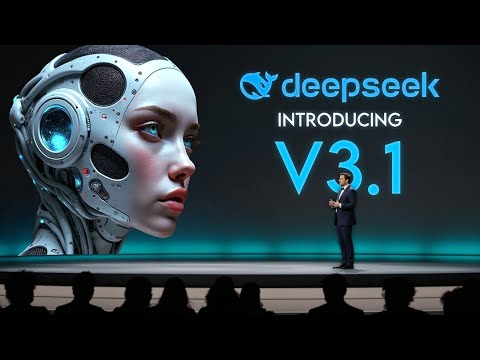
In a surprise move that has taken the AI community by storm, Deepseek v3.1 has been unveiled, showcasing astonishing advancements in open-source AI development. With an unprecedented 685 billion parameters and an expansive 128,000-token context window, Deepseek v3.1 is pushing the boundaries of what is possible in the realm of artificial intelligence. But it’s not just the technical specs that have everyone talking; this model’s exceptional cost efficiency, speed, and reasoning capabilities are setting new standards. As we explore the revolutionary aspects of Deepseek v3.1, it becomes clear that this release marks a crucial turning point in the democratization and evolution of AI technology.
Deepseek v3.1 has caught many by surprise with its impressive performance metrics and capabilities. Featuring 685 billion parameters, this model can handle an extensive range of inputs efficiently, thanks to its massive 128,000-token context window. Interestingly, the release happened without prior marketing or previews, making its impact even more pronounced in the AI community. With a 71.6% score on the Ader programming benchmark, Deepseek v3.1 has already managed to outpace the previous leading model, Claude Opus 4. Perhaps even more remarkable is its cost efficiency, being 68 times cheaper to run, which could lead to substantial savings for enterprises relying on AI for coding tasks.
The technical specifications of Deepseek v3.1 are nothing short of groundbreaking. The model’s 685 billion parameters give it a vast understanding and processing capability, while the 128,000-token context window allows for handling intricate and extensive queries without bogging down. What makes Deepseek v3.1 truly game-changing, however, is its cost efficiency. By being 68 times cheaper to execute compared to its closest competitor, it stands to save considerable operational costs for businesses. This affordability makes it a highly attractive option for enterprises both large and small.
Another essential highlight of Deepseek v3.1 is its unprecedented speed and reasoning capabilities. The model processes complex queries rapidly, overcoming the bottlenecks faced by its predecessors. It utilizes a hybrid architecture that integrates reasoning, chatting, and coding functionalities within a single system. This eliminates the need for multiple AI models to perform different tasks. Additionally, the introduction of hidden tokens for real-time search and internal reasoning ensures more reliable and private answers, enhancing user experience and trust.
Deepseek v3.1’s performance on various benchmarks further solidifies its standing in the competitive landscape. Although it trails behind GPT-5 in certain areas such as graduate-level questioning and advanced software engineering, the proximity in performance is a remarkable achievement for an open-source model. Its ability to handle logical comparisons with fewer mistakes underscores an improved accuracy over its predecessors. This focus on practical applications and operational transparency positions Deepseek v3.1 as a strong contender against established systems.
The release of Deepseek v3.1 comes at a strategically significant moment, coinciding with the rollouts of GPT-5 and Claude 4. By offering version 3.1 as a free download, Deepseek not only captures attention but also highlights its commitment to open-source development. This is in stark contrast to the closed models from American companies that prioritize proprietary systems. Deepseek’s approach aligns with China’s strategy of promoting wider accessibility and adoption through open-source AI, thus democratizing artificial intelligence technology.
Deepseek v3.1’s approach is causing ripples in the traditional economic model of AI development. By drastically reducing operational costs and offering advanced capabilities for free, it forces competitors to justify their pricing strategies. This paves the way for open-source solutions to become preferred options. Cloud providers are already jumping on the bandwagon to offer hosted versions, simplifying usage without local storage needs. This economic disruption signifies that smaller teams and nations can now compete at the forefront of AI development, challenging the monopoly of American tech giants.
The release and success of Deepseek v3.1 not only asserts the potential of open-source AI but also sets a high bar for future developments. With this milestone, it becomes evident that artificial intelligence does not need to remain secluded behind corporate paywalls and geopolitical barriers. The capabilities showcased by Deepseek v3.1 imply that barrier-free sharing of advanced intelligence is both achievable and beneficial. This is more than just another model; it is a transformative moment setting the stage for even more significant advancements with the anticipated release of Deepseek v4.