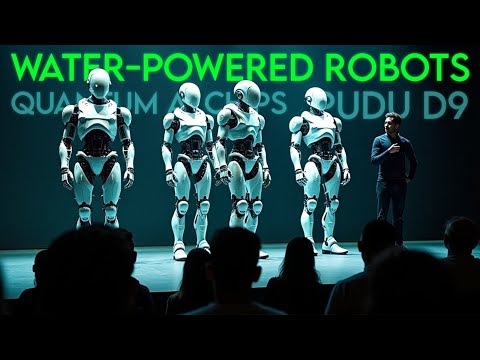
As the year draws to a close, December has brought a host of exciting advancements in the field of artificial intelligence (AI). From quantum computing breakthroughs to sophisticated humanoid robots and cutting-edge AI models, the last month of the year has been a showcase of technological innovation. In this article, we will explore the major highlights, including Google’s quantum computing chip Willow, innovative robots like Clone Alpha and Pudu Robotics’ D9, and significant advancements in AI models from companies like OpenAI, Microsoft, and Meta.
Google’s Quantum Computing Revolution: The Willow Chip
One of the most exciting developments this December is Google’s introduction of the Willow quantum computing chip. This chip marks a significant leap in computational power, achieving below-threshold error rates, meaning it reduces error rates as more qubits are added. Google’s Willow completed the Random Circuit Sampling test in under five minutes, a task that classical supercomputers would take an exorbitant amount of time to finish. This breakthrough sets the stage for more efficient AI training and the handling of complex data sets, with potential applications in fields ranging from medicine to energy.
Humanoid Robots: Clone Alpha and Pudu Robotics’ D9
The realm of robotics has also seen remarkable advancements with the introduction of humanoid robots like Clone Alpha and Pudu Robotics’ D9. Clone Alpha, developed by Clone Robotics, features a biomimetic design with synthetic organs and water-powered muscles that simulate human actions. It is capable of performing household tasks, engaging in conversations, and learning new skills through a custom training platform. Meanwhile, Pudu Robotics’ D9 demonstrates exceptional mobility, efficiency, and dexterity, with two robotic arms and high-precision sensors. This robot is designed to handle complex tasks in environments such as warehouses and retail, showcasing the advanced capabilities of modern robotics.
OpenAI and Microsoft’s AI Model Innovations
In the AI model arena, OpenAI and Microsoft continue to push boundaries with their latest advancements. OpenAI’s reasoning model, version 03, promises enhanced understanding of complex subjects like mathematics and programming. This model aims to approach artificial general intelligence (AGI), raising the bar for future AI applications. On the other hand, Microsoft’s general-purpose AI model, 54, focuses on training quality over quantity, using only 14 billion parameters. This model excels in reasoning and problem-solving tasks while maintaining high ethical standards, ensuring responsible AI development.
AI Video and Image Generation: Google’s VO2 and Beyond
Google has also made strides in AI video and image generation with the release of VO2. This technology creates more realistic and natural videos by better understanding real-world physics and cinematography. VO2 supports outputs up to 4K resolution and generates longer video sequences, providing valuable tools for content creators. The broader adoption of such technologies, including platforms like YouTube Shorts, signals a growing mainstream acceptance of AI in creative workflows.
Meta’s LLaMA 3.3 and VR Integration
Meta has unveiled LLaMA 3.3, a multilingual large language model with 70 billion parameters. Despite its size, LLaMA 3.3 is more efficient and cheaper to run than its predecessors, making it accessible to a wider range of developers. This model is positioned to become a core component of various AI projects, potentially transforming digital interactions and enhancing user experiences through its integration with VR tools.
Ethical Considerations in AI Development
As AI technology advances, ethical considerations remain paramount. The developments in AI models from companies like OpenAI and Microsoft highlight the importance of addressing safety concerns and ensuring transparency in AI’s reasoning processes. Deceptive behaviors in AI, such as those observed in certain models, underscore the need for rigorous ethical oversight and responsible development practices.
Conclusion: The Future of AI Technology
December has been a month rich with groundbreaking advancements in AI technology, setting the stage for future innovations. From quantum computing breakthroughs with Google’s Willow chip to sophisticated humanoid robots and advanced AI models from leading companies, these developments demonstrate the vast potential of AI to transform various industries. As we look to the future, maintaining ethical standards and fostering responsible AI development will be crucial in harnessing the full benefits of these technological advancements.