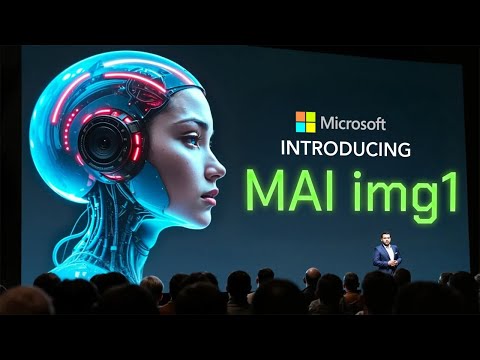
Artificial intelligence has long been a dominant driving force in technology, but recent breakthroughs in AI modeling, image generation, voice search, and open-source innovations are set to reshape the landscape as we know it. The year 2023 has witnessed groundbreaking developments from tech giants like Microsoft, Google, and Ant Group, each contributing unique advancements to the field. From Microsoft’s MAI Image 1 and Google’s nano banana model to Ant Group’s Linget T and Google’s Speech to Retrieval (S2R) technology, these innovations promise to revolutionize how we interact with and utilize AI technology in everyday applications. Let’s delve into these exciting advancements and their potential impacts on the future of AI.
Introduction to AI Technological Advances in 2023
Artificial intelligence continues to evolve at an unprecedented pace, thanks to a series of breakthrough innovations by leading technology companies. These advancements are not only enhancing the capabilities of AI models but also making them more accessible and functional across various platforms. The major contributions of Microsoft, Google, and Ant Group in 2023 have set the stage for the next era of artificial intelligence. By fostering rapid image generation, seamless image editing, and advanced voice search technologies, these companies are redefining what is possible in the realm of AI.
Microsoft’s MAI Image 1: A New Era in Image Generation
Microsoft’s introduction of the MAI Image 1 model marks a significant milestone in AI image generation. Unlike previous models that often relied on specific styles or templates, MAI Image 1 focuses on creating authentic, photorealistic images. The model excels in rendering complex lighting and natural textures, providing unprecedented realism. Furthermore, MAI Image 1 is designed for rapid iteration, enabling quick image generation and smooth integration with editing tools. By ranking among the top 10 models on the LM Arena leaderboard, it showcases its impressive capabilities. Microsoft plans to incorporate MAI Image 1 into various products such as C-Pilot and Bing Image Creator, indicating a strategic shift towards owning the image generation space.
Google’s Nano Banana: Seamless Image Editing within Search
Google has taken a unique approach by integrating its nano banana model directly into the Google search experience. This innovation allows users to generate or edit images effortlessly through the search interface. With the simple click of a create button, users can produce or modify images without leaving the search engine. Nano banana is praised for its capabilities in managing lighting realism and handling edits efficiently. This model enriches user engagement within Google’s existing platforms and democratizes AI-driven image creation for a broader audience, without the need for specialized tools or software.
Ant Group’s Linget T: Pioneering Open-Source AI
Chinese fintech giant Ant Group has made a bold statement by launching Linget T, a massive open-source AI model encompassing one trillion parameters. Linget T aims to challenge established names like OpenAI and DeepSeek in reasoning and code generation tasks. What sets Linget T apart is its open-source nature, promoting global collaboration and transparency. This model has demonstrated strong logical consistency and reasoning capabilities in various benchmarks. By launching Linget T, Ant Group signals China’s commitment to playing a key role in the global AI landscape through openness and a shared advancement approach, rather than operating within an insular market.
Google’s Speech to Retrieval (S2R): Revolutionizing Voice Search
In the realm of voice search, Google has introduced an innovative technology called Speech to Retrieval (S2R). Unlike traditional speech-to-text methods, S2R interprets user intent directly through mathematical embeddings, bypassing the transcription step. This intent-driven approach significantly improves the accuracy of voice search results across different languages and accents. Early tests reveal that S2R offers near-human accuracy in understanding voice queries, setting a new standard for voice search technologies. Additionally, Google has released a public dataset to support further research and development in real-world voice AI applications, reinforcing its commitment to advancing voice search technology.
Conclusion: The Future of AI Technology and Its Broader Impacts
The advancements in AI technology by Microsoft, Google, and Ant Group are not just incremental updates but transformative strides that have the potential to redefine the future of artificial intelligence. From enhancing image generation and editing capabilities to revolutionizing voice search and promoting open-source collaboration, these innovations are paving the way for more functional, accessible, and impactful AI applications. As these technologies continue to develop and integrate into everyday use, we can expect a future where AI becomes even more instrumental in solving complex problems and improving lives globally.