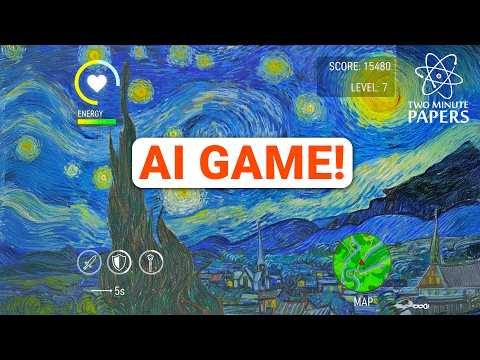
Imagine being able to transform a static image, like Van Gogh’s Starry Night, into an expansive, immersive video game world. This isn’t a far-off dream but a present-day reality thanks to Magica 2, a groundbreaking AI developed by Google DeepMind. Bringing a new dimension to the field of AI technology, Magica 2 allows users to generate playable video games from simple static images. This article delves into the capabilities of Magica 2, contrasting it with previous models such as Genie 2 and Genie 3, and explores its future potential in video game development.
Introduction to Magica 2 and Its Revolutionary Approach
Magica 2 represents a significant leap in the realm of AI technology. Unlike traditional methods that require extensive coding and design, Magica 2 simplifies the process of video game creation by converting static images into dynamic, playable environments. This innovation opens countless possibilities, enabling the rapid creation of video games from diverse image types, such as paintings and sketches. The ability to animate famous artworks into interactive experiences stands as a testament to the transformative potential of this technology.
Comparing Magica 2 with Previous AI Models: Genie 2 and Genie 3
To appreciate the advancements brought by Magica 2, it is essential to understand its predecessors, Genie 2 and Genie 3. While Genie 2 showcased the capability to generate game content, it was limited in terms of memory and smoothness. Genie 3, on the other hand, made significant improvements, providing more coherent storytelling and extended gameplay consistency. Magica 2 surpasses both by offering lower latency and the ability to instantly interact with generated content, revolutionizing user experience with unprecedented efficiency and creativity.
The Technology Behind Magica 2: How It Works
Magica 2 employs a sophisticated diffusion world model similar to its predecessors but with enhanced predictive capabilities. The AI analyzes past frames and player actions to predict subsequent frames, creating a seamless interactive experience. It’s akin to a digital flipbook where each page evolves based on user interaction. This predictive architecture enables Magica 2 to adapt fluidly to various input images, transforming them into engaging game environments effortlessly.
Practical Insights and Limitations of Magica 2
Despite its revolutionary approach, Magica 2 isn’t without limitations. Extended gameplay may reveal a decline in quality and consistency, akin to veering off a well-guided tour path. Character control can sometimes be erratic, leading to less-than-ideal player experiences. However, these limitations reflect the early stage of the technology. Users experimenting with Magica 2 should maintain realistic expectations, understanding that perfection in AI-generated content is a gradual journey.
Future Prospects for AI in Video Game Development
The future of AI-driven video game creation looks promising. As Magica 2 and similar technologies evolve, we can anticipate more sophisticated and consistent interactive experiences. The rapid advancements witnessed within a year highlight the potential for accelerated growth and refinement. Future iterations may overcome current limitations, offering even more immersive and seamless gameplay. The horizon for AI in video game development is expansive, driven by continuous innovation and improvement.
In conclusion, Magica 2 stands as a milestone in AI technology, transforming static images into vibrant video game worlds. While it has its limitations, the potential for future developments is vast. As AI continues to evolve, we can expect increasingly sophisticated tools that redefine video game creation, making it more accessible and dynamic than ever before.