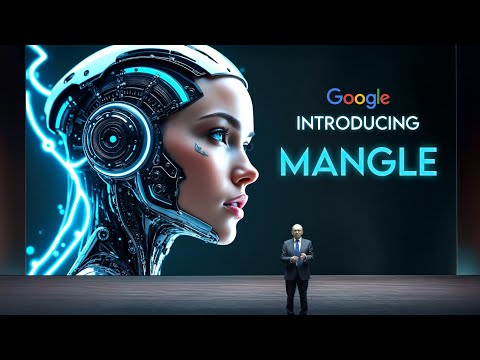
In recent years, Google’s advancements in artificial intelligence (AI) have captivated the tech world, offering transformative tools and systems that promise to redefine data management, image generation, and software development workflows. This article delves into three significant breakthroughs from Google: Mangle, a revolutionary programming language for managing data chaos; Nano Banana, an innovative image generation model; and a suite of AI agents designed to streamline and automate developer tasks. Join us as we explore how these innovations are set to reshape the landscape of AI and software development.
Introduction to Google’s AI Advancements
Google has long been at the forefront of AI research and development, consistently pushing the boundaries of what these technologies can achieve. Their latest advancements focus on addressing some of the most pressing challenges faced by developers and data scientists: managing scattered data, generating high-quality images, and automating repetitive tasks. By introducing new tools like Mangle, Nano Banana, and AI agents, Google is not only enhancing the functionality and accessibility of AI but also paving the way for more efficient and secure software development practices.
Mangle: Simplifying Data Chaos and Enhancing Security
One of the most intriguing introductions from Google is Mangle, a new programming language specifically designed to address the complexities of fragmented and messy data. Modern software systems often struggle with data originating from various sources, such as dependency files and logs, which are in different formats. Mangle simplifies these challenges by enabling users to treat disparate data as a unified logical system. This allows AI tools to run precise queries across all data sources simultaneously.
A standout feature of Mangle is its ability to trace connections through recursive rules, which is particularly useful for security applications. By identifying vulnerabilities in complex library dependencies, Mangle significantly enhances software security. Additionally, it aids in software supply chain management by automating the scanning of software bills of materials (sbombs) to ensure compliance and maintain security standards. Mangle is implemented as a Go library, making it easily integratable into existing applications and AI pipelines, bridging the gap between raw data and structured reasoning for AI systems like Gemini.
Nano Banana: A New Era in Image Generation
In the realm of image generation, a new model named Nano Banana has emerged, quickly captivating users on platforms like LMA Arena. This model stands out for its impressive capabilities in generating high-quality and creative images, as well as its proficiency in performing editing tasks better than existing models. Speculation suggests that Google may be behind this model, especially given recent teasers from their team and social media connections.
The name ‘Nano Banana’ implies that this model is designed to function efficiently on local devices, marking an important evolution in image generation technology. Although it currently struggles with certain tasks such as spelling within images, Nano Banana’s overall performance indicates a potential major advancement in this field. This model hints at Google’s next big project in image generation, promising to bring about significant improvements in how images are created and edited.
Google Cloud’s AI Agents: Automating Developer Workflows
To further transform the developer experience, Google Cloud has introduced a suite of five new AI agents designed to automate and optimize repetitive tasks. These agents include:
- Big Query data agent: Simplifies the creation of data pipelines by interpreting natural language requests and constructing the necessary code for data ingestion.
- Notebook agent: Enhances enterprise research capabilities by making exploratory data analysis and machine learning model building intuitive and conversational.
- Looker code assistant: Streamlines data visualization by generating relevant queries and code based on plain language questions.
- Database migration agent: Facilitates smooth transitions from older databases to modern systems, ensuring minimal downtime.
- GitHub agent: Automates critical repository management tasks within GitHub, freeing developers to focus on more meaningful coding activities.
These AI agents collectively represent a significant shift towards the automation of developer workflows. By reducing the burden of repetitive tasks, they enable developers to concentrate on more complex, creative aspects of software development, positioning Google as a leader in reshaping the software development landscape.
Conclusion: The Future of AI at Google
Overall, Google’s strategic initiatives in AI, ranging from the development of Mangle for data integration to the unveiling of innovative image models and AI agents, reflect a forward-thinking approach aimed at tackling current limitations and enhancing usability across platforms. By focusing on more autonomous developer assistance, Google reaffirms its commitment to advancing AI technology and making it more accessible and functional for everyday software development practices. As these tools continue to evolve and gain traction, they will undoubtedly play a crucial role in shaping the future of AI and software development.