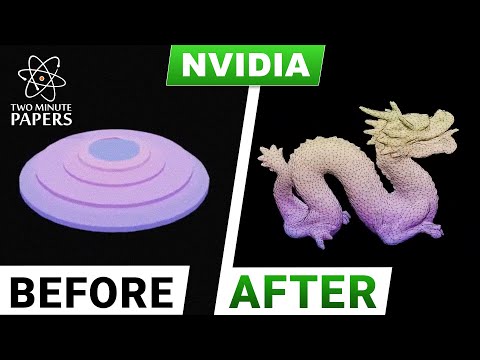
The creation of 3D geometries has come a long way. Once an arduous task limited to skilled artists meticulously crafting models using specialized software, 3D geometry creation is now entering an era of automation powered by Artificial Intelligence (AI). This transformative technology promises to reshape the landscape for animations and video games, making it simpler to build intricate virtual worlds. Join us as we delve into the evolution of 3D geometry creation, explore the challenges faced, and understand the cutting-edge techniques that are making waves in the industry.
Introduction: The Evolution of 3D Geometry Creation
The field of 3D geometry creation has undergone substantial advancements over the past few decades. Traditionally, creating detailed 3D models required extensive manual work by skilled artists using modeling software like Blender. This process was time-consuming, labor-intensive, and demanded a high level of expertise. With the advent of AI technologies, however, there are now significant opportunities to automate this process. AI has already demonstrated its capabilities in generating images and videos from simple text prompts, and similar innovations are emerging in the realm of 3D geometry creation. This shift opens up new possibilities for constructing virtual worlds with minimal artistic input.
Traditional 3D Modeling vs. AI-Generated 3D Models
Traditional 3D modeling involves manually creating each aspect of a model, from its shape and structure to its textures and colors. This meticulous process provides artists with complete control over the final output but can be extremely time-consuming. In contrast, AI-generated 3D models promise to streamline this process by automating the generation of basic shapes and structures. However, initial AI-generated models often lack the quality and usability needed for professional applications, necessitating further refinement from experienced artists.
Challenges and Limitations of AI-Generated 3D Models
Despite the potential of AI in 3D geometry creation, several challenges persist. One of the primary issues is the quality of the generated 3D meshes. These meshes frequently require additional input and refinement by skilled artists to achieve the desired level of detail and accuracy. Furthermore, while AI can assist in the automation of certain tasks, the technology is still not entirely capable of producing fully polished models without some degree of manual intervention.
Cutting-Edge Techniques in AI 3D Geometry Creation
The latest research in AI 3D geometry creation introduces advanced techniques that significantly enhance the quality of the generated models. One notable development involves a novel method that simplifies the editing process by producing a mesh with fewer elements and a thinner structure. This advancement reduces the amount of manual intervention required and allows artists to fine-tune the models more efficiently.
Point Clouds: The Key to High-Quality 3D Models
Point clouds, which are collections of data points in space representing a 3D shape, play a crucial role in the latest advancements in AI 3D geometry creation. By using point clouds as inputs rather than simple text prompts, researchers have been able to overcome some of the limitations of earlier methods. This approach enables the generation of high-quality geometries that require minimal post-processing, marking a significant step forward in the field.
Balancing Detail and Performance in 3D Models
One of the remarkable features of the new AI-driven techniques is the ability to balance detail and performance in 3D models. This is particularly useful for real-time applications such as gaming, where rendering speed is crucial. Users can choose between models with varying polygon counts, allowing them to achieve the desired level of detail while optimizing performance. This flexibility makes it possible to create highly detailed models that are still capable of running efficiently on various platforms.
Future Directions and Innovations in AI 3D Geometry
The future of AI-driven 3D geometry creation looks promising, with ongoing research paving the way for further innovations. Researchers are working towards complete automation of the process, from generating point clouds from text inputs to producing fully polished 3D models. Additionally, innovative AI architectures, such as the ‘neural hourglass architecture,’ are being developed to enhance the capabilities of AI in this field. As these technologies continue to evolve, they hold the potential to revolutionize the way 3D geometries are created, making it more accessible and efficient for artists and developers alike.
In conclusion, AI-powered 3D geometry creation is poised to be a game-changer for the animation and video game industries. By significantly reducing the time and effort required to build detailed 3D models, AI helps artists focus on the creative aspects of their work. As technology advances, we can expect even more sophisticated and user-friendly tools to emerge, further transforming the landscape for 3D model generation.