The realm of football is undergoing a seismic shift thanks to the introduction of artificial intelligence (AI). What was once the domain of human skill and intuition is now the forefront of technological innovation, where AI agents are being trained in simulated environments to perform tasks mirroring those of human soccer players. The acceleration of learning within these powerful computers promises not only advancements in AI training techniques but also groundbreaking applications in the real world. This article delves into how AI is transforming football training, presenting challenges and breakthroughs, and offering a glimpse into the future of sports through the lens of technology.
Introduction to AI in Football
The integration of AI in football encompasses everything from training methods to game analysis, enhancing both the tactical and physical aspects of the game. AI agents, through rigorous training in simulated environments, are developing competencies at a pace beyond traditional methods. This innovative approach not only accelerates learning but opens up new dimensions for strategy development and gameplay analysis in football.
The Power of Simulated Training Environments
Simulated training environments serve as the cradle for AI development in football, where virtual realms are designed to mimic the physics, dimensions, and dynamics of the real-world sport. In these environments, AI agents undergo extensive training, learning and refining skills such as ball control, shot blocking, and tactical play. The advantages of such environments are twofold: they allow for accelerated learning without the physical wear and tear associated with real-world training, and they enable the exploration of innovative strategies and techniques unbounded by human limitations.
Challenges in AI Training for Football
Despite the promising advancements, AI training for football is not without its hurdles. Controlling an AI agent with multiple joints to perform coordinated movements like kicking or blocking a ball involves complex, dynamic control challenges. Teaching these virtual players the basics of movement, let alone the advanced tactics of football, requires overcoming significant obstacles in AI development. Additionally, the transition from a virtual to a physical environment introduces another layer of complexity, demanding that AI agents adapt their learned behaviors to the nuances of real-world physics.
Key Achievements in AI Football Training
AI agents in football have shown remarkable progress, mastering skills at an unprecedented rate. From executing precise kicks to engaging in tactical positioning, these virtual players are demonstrating a level of skill acquisition that surpasses traditional handcrafted training methods. The achievements include faster walking, more agile turning, and enhanced ball control capabilities. Notably, the AI agents’ ability to anticipate play developments and adapt their strategies in real-time represents a significant leap forward in AI sports training.
Sim2Real: Bridging the Gap Between Simulation and Reality
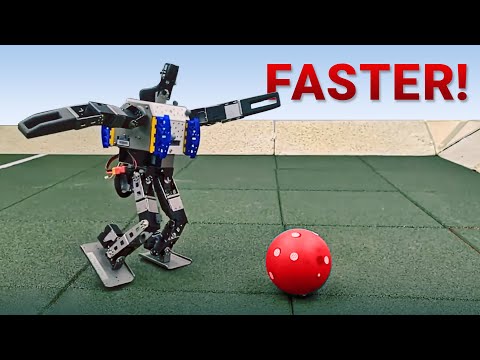
Sim2real projects are at the heart of translating AI’s virtual competencies into real-world applications. By transitioning AI agents trained in simulated environments into robots capable of playing football, researchers are making substantial strides towards creating autonomous players. These robots, equipped with the knowledge and skills honed in the virtual realm, face the ultimate test of adapting to the unpredictable dynamics of real-world play. The success of sim2real initiatives not only demonstrates the potential for AI in sports but also paves the way for further innovations in robotics and autonomous systems.
Conclusion: The Future of AI in Football
The intersection of AI and football heralds a new era for the sport, characterized by unprecedented technological advancements and the promise of enhanced performance, strategy, and entertainment value. As AI continues to evolve, its applications within football are bound to expand, from training and gameplay to fan engagement and game analysis. The journey of AI in transforming football is just beginning, with each breakthrough guiding the way toward a future where technology and sport coalesce in ways once imagined only in the realm of science fiction.