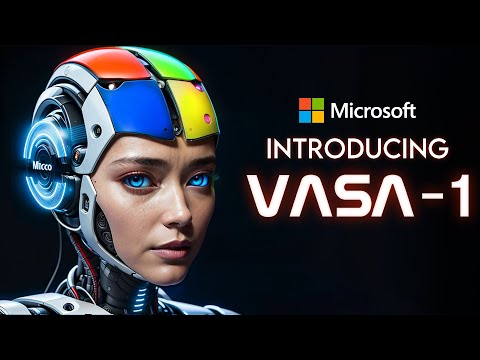
In the realm of digital communication and content creation, the quest for more life-like and expressive avatars has seen significant advancements thanks to developments in artificial intelligence (AI). A standout in this technological evolution is Microsoft’s introduction of the Vasa 1 AI model. This groundbreaking innovation promises to transform the landscape of digital interactions through its generation of remarkably realistic talking faces. Here, we delve into the intricate workings of Vasa 1, scrutinize its real-world applications, face its challenges, and contemplate its future, accompanied by its influential partnership with g42, setting the stage for a new era in digital expressiveness.
Introduction to Vasa 1
Microsoft has made a significant leap forward in the field of artificial intelligence with the development of Vasa 1, an AI model crafted to create lifelike talking faces. This revolutionary model does not only mimic the basal aspects of facial movements but does so with a high degree of realism and expressiveness. Leveraging a diffusion-based model set in a specifically designed latent space for faces, Vasa 1 independently manages intricate facial dynamics. This technology heralds a new era for avatars, bringing them closer to a natural human presence never seen before.
How Vasa 1 Works: A Deep Dive
Vasa 1 stands apart due to its robust back-end framework which orchestrates the facial dynamics and head movements in unison with audio cues and other signals, such as the direction of eye gaze and head pose. By conditioning these elements, Vasa 1 achieves real-time video generation without noticeable delays. Its foundation rests on a vast dataset of face videos, which, paired with a diffusion Transformer architecture, crafts an expressive and modular latent space. This setup fine-tunes the management of motion distribution, crucial for the realistic renderings of facial expressions and head movements.
The Real-World Applications of Vasa 1
The implications of Vasa 1 are vast and varied, affecting multiple facets of digital interaction and content creation. From transforming digital communication to offer more authentic interactions, aiding individuals with speech impairments, to refining lip syncing in gaming, the potential applications are vast. In addition, it paves the path for revolutionary uses in creating virtual avatars for social media engagement, and enhancing AI-based movie production, showing Vasa 1’s capability to dramatically improve our digital experiences.
Overcoming Challenges: A Look at Vasa 1’s Future
Despite its advancements, the journey of Vasa 1 is not without its hurdles. Key challenges include the integration of full-body dynamics, the management of non-rigid elements like hair and clothing, and safeguarding against the model’s misuse for creating deceptive content. These issues underscore the need for continuous refinement of Vasa 1, with a special focus on developing tools for forgery detection to ensure ethical use of this technology.
Microsoft and g42: A Strategic Partnership
The collaboration between Microsoft and g42 is strategic, aiming to bolster the global utilization of Vasa 1 technology, with a spotlight on sectors such as healthcare, education, and customer support. This partnership not only demonstrates a shared vision for the future of AI innovations but also aims to enhance AI skills in the UAE and neighboring regions, demonstrating the potential of Vasa 1 to serve as a cornerstone for local and global AI advancements.
Conclusion: The Impact of Vasa 1 on Future Technologies
The development of Microsoft’s Vasa 1 marks a milestone in the pursuit of hyper-realistic digital avatars. By overcoming the once insurmountable barrier of uncanny, lifeless digital representations, Vasa 1 sets a new precedent for the future of AI in digital communication and beyond. As we look ahead, the continued evolution of Vasa 1 promises to not only enhance our digital interactions but also redefine our expectations of technology’s capability to replicate the nuances of human expression and interaction.