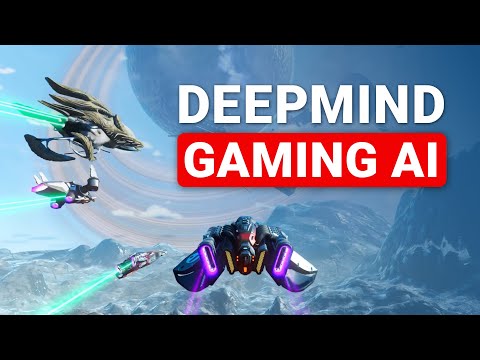
Artificial Intelligence (AI) has been making waves across various sectors, but its integration into the realm of gaming is arguably one of the most thrilling advancements. DeepMind, a leader in AI research, has once again broken new ground with its development of an AI capable of handling multiple modern 3D games simultaneously. This monumental achievement not only highlights the sophisticated level of current AI technologies but also sets a new benchmark for AI’s role in gaming, extending its potential utility to broader, real-world applications. Through this journey, we’ll explore the nuances of DeepMind’s multifaceted AI, its capabilities, limitations, and the implications of such technology.
Introduction to DeepMind’s Multifaceted AI
At the heart of DeepMind’s latest innovation is an AI that demonstrates a remarkable ability to engage with various modern 3D games at the same time. This development marks a significant departure from previous iterations of game-specific AI technologies. The key to its design is not the sheer computational power to outscore opponents but the ability to understand and interpret human instructions, make decisions, and execute actions by analyzing screen pixels in a manner akin to human cognition. This approach represents a quantum leap towards achieving human-like intelligence in gaming environments.
Beyond Scoring Points: A Leap Towards Human-Like Gaming Intelligence
DeepMind’s AI transcends the traditional objectives of maximizing points and game victories. It is engineered to comprehend and execute tasks based on human instructions, signifying a closer step towards human-like reasoning and interaction within digital environments. This approach reflects a paradigm shift in AI gaming, emphasizing the development of AI systems that can understand and navigate games through the lens of human experience and strategy rather than simple score optimization.
The Superior Generalization of AI across Varied Gaming Environments
A distinguishing characteristic of DeepMind’s AI is its superior ability to generalize knowledge and skills across different gaming contexts. Unlike its predecessors, which were tailor-made for specific games, this AI leverages the insights gained from one game to enhance its performance in another. This capability of transferring learned skills to new, unencountered environments showcases a crucial aspect of intelligence—adaptability. As a result, the AI’s performance not only surpasses that of specialized AIs but also embodies a more natural, intelligence-like flexibility.
Limitations and Potential: Assessing Current Capabilities and Future Directions
Despite its groundbreaking achievements, DeepMind’s AI is not without limitations. Currently, it excels in short-term planning and immediate decision-making but falls short of human-like competence in long-term strategic thinking. This gap indicates significant areas for future research and development, emphasizing the need to enhance AI’s ability to engage in deeper, more complex reasoning and planning over longer horizons. Addressing these challenges is crucial for the next evolution of AI systems.
Beyond the Game: Envisioning AI’s Role in Complex Real-World Tasks
The implications of DeepMind’s advances extend far beyond the gaming industry. The ongoing research aims to leverage AI’s potential in assisting humans in managing complex tasks within 3D environments, which could revolutionize numerous fields such as healthcare, logistics, and urban planning. By evolving AI systems to understand and interact within multifaceted 3D worlds, the technology holds the potential to offer innovative solutions to some of the most pressing challenges faced by humanity today.
The journey of AI, especially in the realm of gaming, is a testament to human ingenuity and the unending quest for knowledge. As we stand on the precipice of these new technological advancements, it’s clear that the future of AI is not just about playing games—it’s about changing the game across multiple worlds, virtual and real.